Tehran Justifies Regional Attacks While Gulf States Report Lasting Diplomatic Damage
The Islamic Republic has justified its military operations against neighboring Gulf nations, asserting that American military installations within these territories constitute valid targets in its conflict with Washington and Tel Aviv.
However, regional governments have expressed that these assaults have generated a significant breach of confidence that could persist for many years.
Tehran’s choice to strike neighboring countries as part of its response to American-Israeli military actions has puzzled observers, with Iranian officials delivering contradictory statements regarding their approach. The regime has alternated between expressing regret for attacks on nations such as Saudi Arabia, the United Arab Emirates, Qatar, and Bahrain, while simultaneously conducting additional strikes.
Speaking to media on Monday, Iran’s foreign ministry representative stated that the nation harbors no animosity toward Gulf countries, while maintaining that American military facilities in the area represent valid targets.
Esmail Baghaei, the foreign affairs ministry spokesman, emphasized that Iran bears no ill will toward regional nations, including the UAE and Bahrain. He questioned whether Iran initiated the conflict or if hostilities were imposed upon the country without justification.
Baghaei characterized Iran’s targeting of American military installations and equipment in the region as permissible under international law, citing Article 51 of the UN Charter as justification for defensive actions.
The spokesman declared that all military facilities and assets supporting what Iran considers aggressor nations would be viewed as legitimate targets, noting that American military bases surround Iran throughout the region.
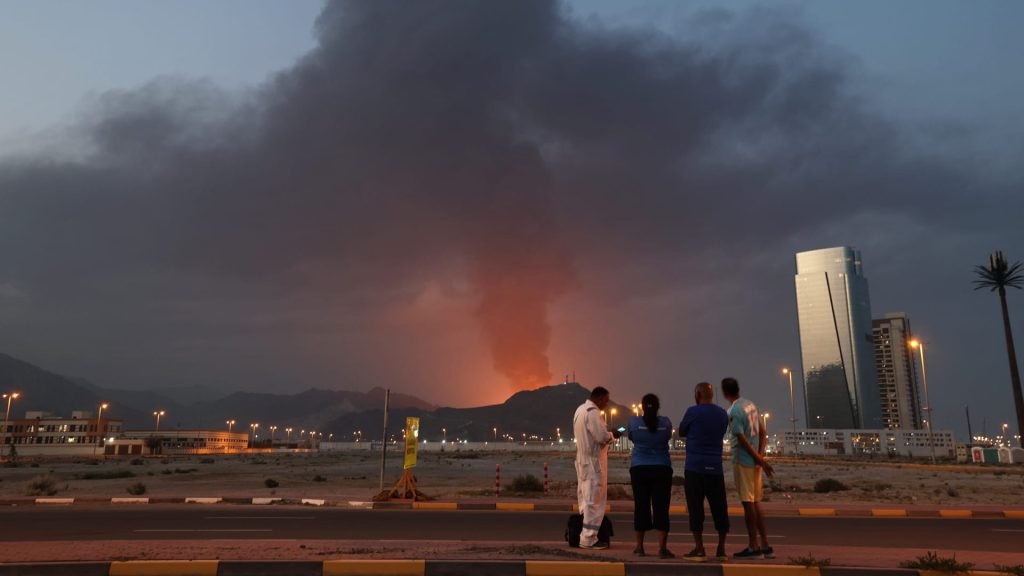
While Tehran maintains it has focused solely on military targets, evidence indicates that Iranian strikes have damaged critical energy infrastructure, particularly petroleum facilities, alongside military installations in neighboring states.
Iranian unmanned aircraft and strike debris have impacted civilian infrastructure across the Gulf region, affecting airports in Dubai and Abu Dhabi, as well as hotels and residential areas. Intercepted missiles and drones have resulted in civilian and military casualties, including several deaths.
Security experts suggest this approach aims to maximize pressure on Iran’s immediate neighbors while demonstrating Tehran’s capacity to destabilize global markets and disrupt oil supplies.
The strategy also appears designed to encourage affected Gulf nations, concerned about protecting their diversifying economies, to pressure the United States and Israel to cease their aerial campaign against Iran.
Regional neighbors have expressed strong disapproval of Iranian actions, warning that diplomatic relationships could suffer long-term consequences.
A high-ranking UAE official indicated that while regional relations with Iran might eventually recover due to geographical proximity, the current situation has created a substantial trust deficit that could endure for decades.
Qatar’s leadership has strongly denounced Iranian attacks on their nation and other Gulf countries, completely rejecting Tehran’s justifications for the strikes.
The Gulf Cooperation Council, representing six regional states, has condemned what it terms Iran’s treacherous and heinous attacks, pledging to implement all necessary defensive measures to protect member territories and security.
While nations like Saudi Arabia and the UAE have threatened retaliation against Iran, they have refrained from taking potentially escalatory actions thus far.
Iran has acknowledged the damage to its already strained relationships with neighboring countries while continuing similar military operations.
Iranian President Masoud Pezeshkian recently apologized for the attacks, stating that Iran has no intention of invading other nations and calling for setting aside regional disagreements. However, shortly after this statement, Iran launched rockets toward an American air base in the UAE.
Pezeshkian’s apology generated criticism from hardline elements within Iran’s Revolutionary Guards and religious leadership, with conservative cleric Hamid Rasai publicly criticizing the president’s stance as unprofessional and weak.
Despite reiterating the presidential apology, spokesman Baghaei maintained that neighboring countries are being exploited by the United States for attacks against other Muslim nations.
Former Israeli Ambassador to the United States Michael Herzog noted that Gulf residents he has consulted are genuinely upset with Iranian actions. He observed that Iran’s targeting of Gulf infrastructure and civilian areas, beyond American bases, appears aimed at pressuring the current administration to end hostilities sooner.
Herzog suggested that this strategy has backfired for Iran, isolating the country regionally and uniting Gulf states in opposition. He believes Iran miscalculated in attempting to demonstrate that the conflict would become regional in scope.